
Its no coincidence that the first reported sightings of unidentified flying objects came after the revelations of the secret military projects of World War II. America has always been a land of invention, from the cotton gin to the telephone, from the airplane to the MOTEL (1925). But wartime inventions raised the status of our technology from awe-inspiring to mythic. Working in total secrecy while spending billions of dollars building whole cities and manufacturing plants, the Manhattan Project succeeded in extracting the energy of the atom and building a doomsday weapon. What could not be accomplished by the American military working in secret? What else was being accomplished?
This was the background for sightings of peculiar objects in the skies, beginning in June 1947, in the Southwestern desert area which had so many secret military installations. The objects could be some new super-secret aircraft developed by the U.S. military. Or could they have been developed by some other technologically advanced beings, perhaps from beyond the Earth or the solar system? After all, we now knew that the technology to permit space travel was possible. And these elusive objects traveled far faster and maneuvered far more adroitly than even a jet airplane.
There were many skeptics, however, who considered the objects pie in the sky--or more exactly "flying saucers" (1947), since excited observers had described the objects as saucer-shaped. The name flying saucers caught on, making serious research difficult. As a 1953 book Flying Saucers Have Landed complained, "ever since the cliché 'flying saucer' was coined, the greatest and most exciting mystery of our age has been automatically reduced to the level of a music hall joke."
The believers preferred the solemn government designation unidentified flying object, first used in 1950. But that was a little weighty for everyday use, so in 1953 the acronym UFO was coined to replace it. It has dignified the pursuit of the elusive objects ever since. Those who study them have been known at least since 1959 asufologists, and their field of study has been ufology. But most people still couldn't find the alien spaceship in the tail of the Hale-Bopp comet of 1997, and the saucers--oops, UFOs--still haven't landed on the White House lawn.
Top
The UFO phenomenon consists of reports of unusual flying objects that remain unidentified after scientific inquiry. It first came to public attention in the United States in 1947, when a pilot reported seeing nine unusual objects flying in formation in the state of Washington. Since 1947, the U.S. federal government, private research institutions, and individual scientists have collected data about the phenomenon. Although UFOs are not a phenomenon unique to the United States, American organizations and private individuals have taken the lead in collecting, analyzing, and publishing sighting reports.
The most publicized collection agency was the U.S. Air Force through its Projects Sign (1948), Grudge (1948–1951), and Blue Book (1951–1969). The Air Force also sponsored research by the Battelle Memorial Institute in 1955 and the University of Colorado in the late 1960s. The Federal Bureau of Investigation, the Central Intelligence Agency, and other U.S. government agencies also looked into the phenomenon. Congressional hearings were held on the subject in 1966 and 1968. The goal of the U.S. government was to determine whether the UFO phenomenon was a threat to national security. Unable to find the threat, the government stopped collecting reports from the public in 1969.
Private research institutions, including the Aerial Phenomenon Research Organization (APRO), the National Investigations Committee on Aerial Phenomena (NICAP), the Mutual UFO Network, the J. Allen Hynek Center for UFO Studies, and the Fund for UFO Research, have collected and analyzed reports since 1952. Even the American Institute of Aeronautics and Astronautics (AIAA) conducted a study in 1971.
Nearly all research efforts have determined that a small but significant number of sightings remain "unidentified" after scientific investigation. This is especially true with reports made by the most articulate witnesses and containing the most data. Although the primary objective of private UFO researchers was to collect and analyze reports, they also sought to convince the public and the scientific community of the legitimacy of the subject. Their task was made all the more difficult by ridicule, caused in part by the perceived unlikelihood of the phenomenon's extraterrestrial origin, and in part by publicity hungry charlatans and self-promoters ("contactees") who, beginning in the 1950s, made fictitious claims about meeting "space brothers" and traveling to distant planets, or hinted darkly about secret government conspiracies with aliens.
In addition to the problem of ridicule, serious researchers found it difficult, although not impossible, to gather "hard" evidence of the unconventional nature of the phenomenon. They amassed photos, films, videotapes, radar tracings, and great numbers of multiple witness reports of objects on or near the ground. They reported studies of UFO effects on electrical and mechanical devices, animals, and humans. They studied soil samples purportedly altered by landed UFOs. In spite of all this, they were unable to present artifacts of a UFO—the hard evidence that most scientists demanded.
Since the late 1940s, the UFO phenomenon has entered U.S. popular culture, and it has become a staple of motion pictures, television shows, advertising copy, and media images. As early as 1950 it proved to be one of the most recognized phenomena in Gallup Poll history, and it has continued to play an important role in popular culture.
In the early 1960s, people began to claim that they were abducted into UFOs. Although UFO researchers at first considered these reports to be an "exotic"—and probably psychological—sidelight of the main sighting phenomenon, abduction accounts grew steadily in number. Evidence for abductions was mainly derived from human memory, usually retrieved through hypnosis. But the people who reported being abducted were not "contactees" or self-promoters and appeared to be genuinely concerned about what had happened to them. In the 1980s, the numbers of people who came forward with abduction accounts had begun to rise dramatically, and a 1998 Roper Poll of 5,995 adults suggested that as many as a million Americans believed they had been abducted. By the end of the twentieth century, the abduction phenomenon had come to dominate UFO research.
In spite of extensive efforts in the second half of the twentieth century, attitudes toward the legitimacy of the UFO phenomenon and the research into it changed little. At the beginning of the twenty-first century, researchers had failed to convince the scientific community of the phenomenon's legitimacy, they had not developed a standardized methodology to retrieve alleged abduction accounts, and no UFO organization had gained the academic backing to professionalize both UFO and abduction research. Yet after half a century of study, UFO proponents had advanced knowledge of the subject greatly, and some even claimed that a solution to the mystery of UFO origins and motivations seemed possible.
In the twenty-first century, the UFO phenomenon persisted, apparently unaffected by societal events. It continued to maintain a ubiquitous presence in popular culture, researchers continued to study it, and, although scientists and academics still scorned it, ordinary people continued to report both sightings and abduction accounts.
These are undoubtedly a very important source of misidentification. There are numerous different types of such vehicles and we must consider five main ones: ordinary aircraft, military aircraft, advertising planes, gliders, and helicopters. Each has different aspects of relevance to the UAP researcher.
Aircraft can be interpreted as UAP under many circumstances, day and night. In daytime it is quite possible for strong sunlight to reflect from the polished metallic surface and give an appearance of an oval or cigar-shaped object. Protuberances, such as wings, can be made invisible by this. Daylight aircraft approaching along a witnesses’ line-of-sight can also appear as a stationary “domed-disc” for several minutes. Aircraft types vary widely and yet they all have a standardized appearance. Nonetheless, under certain conditions any aircraft can look extraordinary, especially if the witness hears no sound. Some modern jets are quiet, and if a fairly strong wind is blowing away from the witness and towards the aircraft then it could appear to be silent.
At night, aircraft are illuminated for reasons of air safety. The forms of navigation lighting they employ are universally adhered to throughout the world, albeit with some degree of flexibility. By law, an airborne aircraft must bear a steady red light on its left side, and a steady green light on its right (positioned on the wingtips in the case of an airplane). Additionally, they often also bear strobe and/or static white lights (again, in regards to airplanes, on each wing). A reddish/orange flashing anticollision beacon is mounted on the centre of the aircraft’s upper and lower fuselage. Finally, the tail may bear a steady white light, in addition to any other lumination (as described below). Due to these combinations it is possible for a witness to describe all manner of coloured lights. Under certain conditions green can look blue, red can look yellow, and so on. Consequently it is not that important whether or not the lights described conform to the expected aircraft navigation lighting. If the object described by the witness performs as an aircraft would perform then one might conclude this is a feasible explanation.
There are three other aspects of aircraft lighting that must be considered. Firstly, thesearchlight. Some aircraft do employ these for ground illumination, but some bright searchlights are also employed at the front of aircraft as landing lights. Although meant only for the final stages of landing, if traffic is light (or conditions are notably foggy) aircraft do switch these on kilometres from touchdown. The sight presented by one of these is spectacular – a single (or two adjacent) brilliant ball(s) of white or yellowish light. If travelling directly towards you it can be seen from many kilometres away, and will appear virtually stationary for up to several minutes. In all probability it will also be quite silent at that distance.
Strobe lighting is becoming more popular nowadays and consists of regular brief flashes of extreme intensity (like a photographic flashgun). It can be seen from some distance, which is one of its chief advantages, but due to its brilliance can lead the eye to see many strange motions and shapes that are not present in reality. Finally, many commercial jets are now using steady white “Logo Lights”. These allow the symbol of the airline, usually on the tail fin, to be visible. Since all manner of symbols are used the world over nobody should be alarmed if flying dragons or fiery lions are seen crossing the sky in the wake of an aircraft!
Another effect to note is the tendency of witnesses to perceive darkened spurious shapes within a configuration of aircraft navigation lights.
It should by now be very apparent that there are so many factors involved in aircraft observation that multiplicities of possible misidentifications exist. Fortunately, it can be a simple matter to confirm or disprove the existence of a civil aircraft in any vicinity at a specific time, provided checks are made fast enough with local airports. There are also standard airways (termed air corridors) along which an aircraft en route must travel. Their location can be checked by reference to major civil airports, and local aviation clubs can supply you with up-to-date maps of these corridors around your area, together with information such as maximum and minimum flying heights allowed along them. There is certainly some justification for checking aircraft movements on every case where this is possible.
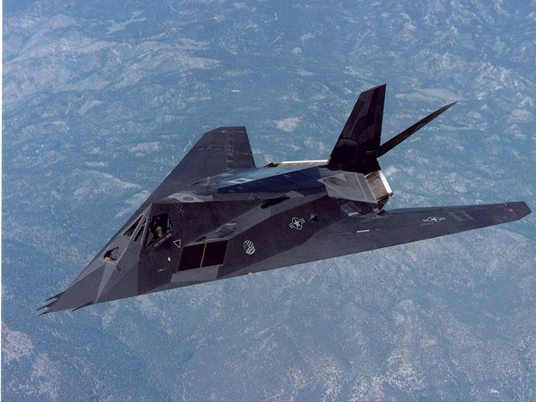
F-117 stealth fighter
Military aircraft present more problems. Civil airports may know of flights or an exercise in their airspace, but it is by no means impossible that they would not. One can check with the nearest military base and they may or may not be co-operative. A great deal depends on the nature of the operation involved. Such aircraft can, of course, fly much faster than civil aircraft, and they sometimes fly in formations. This is true of “refuelling missions”, where one aircraft is fuelled in-flight by another. It is speculated that some stories of “mother ships” and their “baby” UAPs are attributable to the tanker aircraft and one or several smaller jets being refuelled.
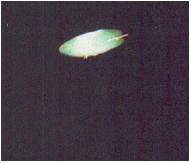
Lighted Virgin blimp Photo: Science et Vie (1997)
Advertising airships (such as the Virgin Lightship) utilise either an aircraft with the capability to fly extremely slow equipped with hundreds of lights on the underside, or an airship with a similar array of lights along its sides. These can be lit up in various sequences to spell out advertising messages and the effect can be remarkable. However, when viewed from a distance and at a shallow angle all that is seen is a random pattern of lights that may zchange or pulsate. Experience in the USA with advertising aircraft has taught that witnesses will read many exotic UAP shapes into these with ease (often perceiving them as a rotating “domed disc”).
Gliders are not flown at night since they would be too dangerous, but in daylight they may look somewhat odd when seen from a distance, and of course there is no sound associated with them.
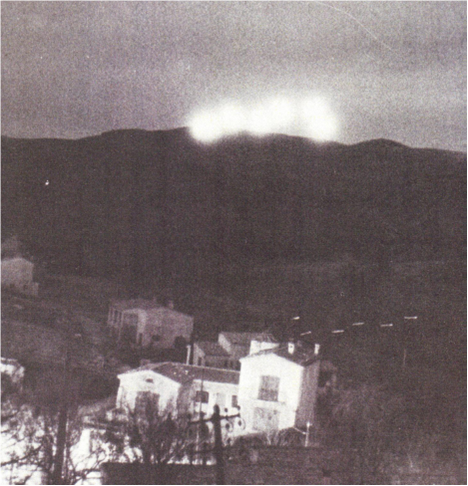
Helicopters. Photo: La nouvelle vague des soucoupes volantes, J-C. Bourret, 1974.
Then there are helicopters. While infrequently conducted until the 1990’s, night time flying is now becoming increasingly common due to advances in avionics and night vision technology, especially in regard to the military. As with aircraft they are equipped with both a searchlight and navigation lights. Their more notable attributes are manoeuvrability, (much more pronounced than an aircraft, especially during daylight), a lower operational ceiling, generally slower speeds and an ability to hover for extended periods of time. Naturally, sightings of helicopters can be very puzzling (especially at night). The unfortunate thing about aircraft is that it is not always possible to prove that one was in an area, even if one does check right away. Aircraft details are often logged by an airport and you may be able to discover that one was heading inwards (or outwards) from (or to) a certain place, and would pass by the sighting location at a reasonably precise time. However, many airports now ask for substantial search fees to acquire such data, and the present security situation may make them hesitant to supply it in any event, especially to a person previously unknown to them. Another (cheaper) option is to check online flight schedules to determine if any aircraft may have been in the vicinity during the sighting – knowledge of local air corridors and orientations of local airport runways in regard to a “suspect” flight being essential for this approach to be viable. Whatever the method, if one has not traced an aircraft then one must not dismiss the possibility that one was in fact seen.
Telltale signs: Flashing lights (at night), steady speeds (between about 100 and 600 Mph), vicinity of an airport or airway, possible droning or whining sound. Duration usually around 2 minutes up to half an hour.
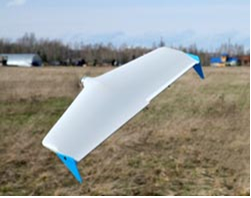
Russian UAV, ZALA 421-08
The last type to consider is UAVs (or Unmanned Aerial Vehicles). Once confined to battlefield and military exercise areas, UAVs are increasingly being used by civilian bodies such as the Police and County Councils for surveillance and similar duties. They are not “robotic” aircraft in the true sense but remotely operated by a ground controller located a relatively short distance away. Most utilise airframes resembling a combination of a missile, model aircraft and/or a helicopter (with some military versions incorporating angular radar stealth “streamlining”). Disc shapes and flying wing designs also exist but are deployed less often. Presently, the optimum size of a UAV is around 15-40 cm or more – smaller variations having very low operational ranges. Larger UAVs, on the other hand, can have an endurance of 2 days or more.
The majority utilise fairly quiet propellers or ducted fans for propulsion. While relatively slow many are capable of hovering (especially those with helicopter configurations) and all have excellent agility. Operational heights tend to be fairly low, and civilian models tend to be used during the day only in ideal weather conditions (i.e. no strong winds, heavy rain or fog).
Telltale signs: A small oval, glider or “rocket” shaped object performing agile motions (with occasional static periods) over a significant public event (rally, football match, etc.), urban area or military exercise/proving ground. The presence of a police surveillance van or similar vehicle may also be noted in the area.
1. Your exact LOCATION. Nowadays anyone can easily determine its precise longitude and latitude using Google Earth or a website (e.g. http://www.satsig.net/maps/lat-long-finder.htm)


Where possible the direction of the observed phenomena can be indicated by arrow, as well as the duration of the sighting. The times at the various intermediate positions occupied by the phenomenon shoule also be shown (especially, at the position it might have changed shape, color, speed, direction, altitude…). If a light phenomenon became brighter, and then gradually faded, it can be represented by a line becoming increasingly


Finally, the last important things to remember to do while the sighting is in progress are:
- Get additional witnesses, if possible,
- Take pictures or use a camcorder to record the event,
- Rapidly write down your description of your observation,
Viewing Tips
One of the main objective of this website (ref. Misidentifications Tab) is to assist the general public when having observed an unusual aerial event to confirm or eliminate a known object or phenomena as the potential source of the event witnessed, and therefore to isolate the interesting UAP from the IFO (Identified Flying Objects). However, this might prove to be a very difficult exercise when some important observation details are missing.
It is therefore also necessary to provide advice to the general public, before any UAP sighting, on the best way to handle any unusual aerial perception. This is how the witness can help the investigation. Indeed, it is of utmost importance that people learn to vigorously observe, accurately perceive, and precisely relate UAP observations.
WHAT IS THE BEST WAY TO DOCUMENT A SIGHTING (WHEN OCCURRING)?
The few important features that you must remember to look for are:
1. Your exact LOCATION. Nowadays anyone can easily determine its precise longitude and latitude using Google Earth or a website (e.g. http://www.satsig.net/maps/lat-long-finder.htm)
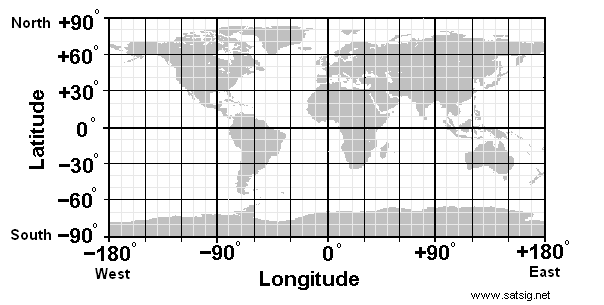
2. Approximation of the TIME (and relevant time zone).
A cell phone can be used for an accurate data.
A cell phone can be used for an accurate data.
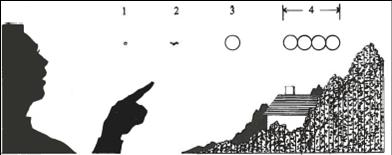
3. Apparent size of the phenomena, also called ANGULAR SIZE.
It refers to the amount of area that a given object seems to occupy in the sky, based on its size and distance from the witness. One of the most common ways of determining angular size is to hold a common object at arm’s length for comparison. A more easy way (proposed by A. Hendry in “The UFO Handbook”, p19) is to use four types of apparent sizes: 1= a star, 2= a distant plane, 3= the moon, 4= several moons put together.
It refers to the amount of area that a given object seems to occupy in the sky, based on its size and distance from the witness. One of the most common ways of determining angular size is to hold a common object at arm’s length for comparison. A more easy way (proposed by A. Hendry in “The UFO Handbook”, p19) is to use four types of apparent sizes: 1= a star, 2= a distant plane, 3= the moon, 4= several moons put together.
4. DISTANCE
Difficult to estimate, unless the phenomena passes in front of an object for which the distance is known.
5. AZIMUT
An azimuth is an angular measurement in a spherical coordinate system. This is used to define positions of the event of the event, in relation to where the phenomena has been observed the first time, the last time, and if possible during these moments. Azimut is usually measured in degrees, and is represented by a 360° circle that starts and ends at due North. This one being at 0°, East at 90°, South at 180 °, West at 270 °.
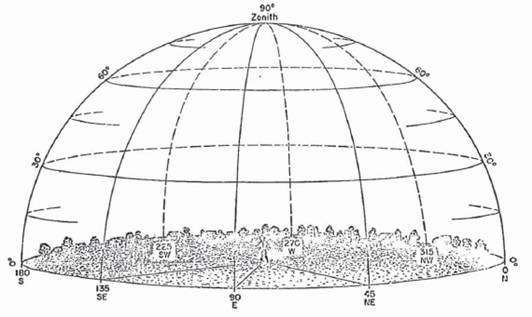
Where possible the direction of the observed phenomena can be indicated by arrow, as well as the duration of the sighting. The times at the various intermediate positions occupied by the phenomenon shoule also be shown (especially, at the position it might have changed shape, color, speed, direction, altitude…). If a light phenomenon became brighter, and then gradually faded, it can be represented by a line becoming increasingly
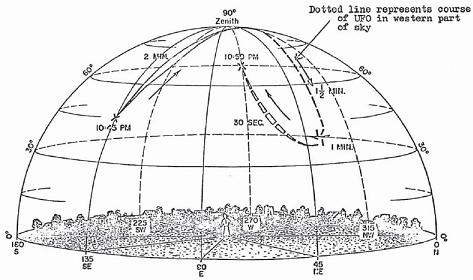
thicker and then gradually thinning out to nothing. Further details could also be added. Also, if any prominent landmarks such as mountains, buildings, or specific installations, trees, etc…are part of the sighting area, they could also be included in the drawing. An example of such plot is as follows (Source: APRO 1972, recommended procedures for field investigators)
6. ELEVATION ANGLE (above the horizon)
A phenomenon sighted on the horizon is at an elevation angle of 0°, at zenith (directly overhead) at 90°, and halfway at 45°.
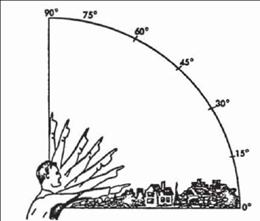
(Illustration source: APRO 1972, recommended procedures for field investigators)
7. OTHERS
Finally, the last important things to remember to do while the sighting is in progress are:
- Get additional witnesses, if possible,
- Take pictures or use a camcorder to record the event,
- Rapidly write down your description of your observation,
- Contact the locals news media and immediately file a report to a UFO research organization (…including this website, with the related sighting forms under the ”Reporting tab”) for investigation.
These are undoubtedly a very important source of misidentification. There are numerous different types of such vehicles and we must consider five main ones: ordinary aircraft, military aircraft, advertising planes, gliders, and helicopters. Each has different aspects of relevance to the UAP researcher.


These are undoubtedly a very important source of misidentification. There are numerous different types of such vehicles and we must consider five main ones: ordinary aircraft, military aircraft, advertising planes, gliders, and helicopters. Each has different aspects of relevance to the UAP researcher.
Aircraft can be interpreted as UAP under many circumstances, day and night. In daytime it is quite possible for strong sunlight to reflect from the polished metallic surface and give an appearance of an oval or cigar-shaped object. Protuberances, such as wings, can be made invisible by this. Daylight aircraft approaching along a witnesses’ line-of-sight can also appear as a stationary “domed-disc” for several minutes. Aircraft types vary widely and yet they all have a standardized appearance. Nonetheless, under certain conditions any aircraft can look extraordinary, especially if the witness hears no sound. Some modern jets are quiet, and if a fairly strong wind is blowing away from the witness and towards the aircraft then it could appear to be silent.
At night, aircraft are illuminated for reasons of air safety. The forms of navigation lighting they employ are universally adhered to throughout the world, albeit with some degree of flexibility. By law, an airborne aircraft must bear a steady red light on its left side, and a steady green light on its right (positioned on the wingtips in the case of an airplane). Additionally, they often also bear strobe and/or static white lights (again, in regards to airplanes, on each wing). A reddish/orange flashing anticollision beacon is mounted on the centre of the aircraft’s upper and lower fuselage. Finally, the tail may bear a steady white light, in addition to any other lumination (as described below). Due to these combinations it is possible for a witness to describe all manner of coloured lights. Under certain conditions green can look blue, red can look yellow, and so on. Consequently it is not that important whether or not the lights described conform to the expected aircraft navigation lighting. If the object described by the witness performs as an aircraft would perform then one might conclude this is a feasible explanation.
There are three other aspects of aircraft lighting that must be considered. Firstly, thesearchlight. Some aircraft do employ these for ground illumination, but some bright searchlights are also employed at the front of aircraft as landing lights. Although meant only for the final stages of landing, if traffic is light (or conditions are notably foggy) aircraft do switch these on kilometres from touchdown. The sight presented by one of these is spectacular – a single (or two adjacent) brilliant ball(s) of white or yellowish light. If travelling directly towards you it can be seen from many kilometres away, and will appear virtually stationary for up to several minutes. In all probability it will also be quite silent at that distance.
Strobe lighting is becoming more popular nowadays and consists of regular brief flashes of extreme intensity (like a photographic flashgun). It can be seen from some distance, which is one of its chief advantages, but due to its brilliance can lead the eye to see many strange motions and shapes that are not present in reality. Finally, many commercial jets are now using steady white “Logo Lights”. These allow the symbol of the airline, usually on the tail fin, to be visible. Since all manner of symbols are used the world over nobody should be alarmed if flying dragons or fiery lions are seen crossing the sky in the wake of an aircraft!
Another effect to note is the tendency of witnesses to perceive darkened spurious shapes within a configuration of aircraft navigation lights.
It should by now be very apparent that there are so many factors involved in aircraft observation that multiplicities of possible misidentifications exist. Fortunately, it can be a simple matter to confirm or disprove the existence of a civil aircraft in any vicinity at a specific time, provided checks are made fast enough with local airports. There are also standard airways (termed air corridors) along which an aircraft en route must travel. Their location can be checked by reference to major civil airports, and local aviation clubs can supply you with up-to-date maps of these corridors around your area, together with information such as maximum and minimum flying heights allowed along them. There is certainly some justification for checking aircraft movements on every case where this is possible.
F-117 stealth fighter
Military aircraft present more problems. Civil airports may know of flights or an exercise in their airspace, but it is by no means impossible that they would not. One can check with the nearest military base and they may or may not be co-operative. A great deal depends on the nature of the operation involved. Such aircraft can, of course, fly much faster than civil aircraft, and they sometimes fly in formations. This is true of “refuelling missions”, where one aircraft is fuelled in-flight by another. It is speculated that some stories of “mother ships” and their “baby” UAPs are attributable to the tanker aircraft and one or several smaller jets being refuelled.
Lighted Virgin blimp Photo: Science et Vie (1997)
Advertising airships (such as the Virgin Lightship) utilise either an aircraft with the capability to fly extremely slow equipped with hundreds of lights on the underside, or an airship with a similar array of lights along its sides. These can be lit up in various sequences to spell out advertising messages and the effect can be remarkable. However, when viewed from a distance and at a shallow angle all that is seen is a random pattern of lights that may zchange or pulsate. Experience in the USA with advertising aircraft has taught that witnesses will read many exotic UAP shapes into these with ease (often perceiving them as a rotating “domed disc”).
Gliders are not flown at night since they would be too dangerous, but in daylight they may look somewhat odd when seen from a distance, and of course there is no sound associated with them.
Helicopters. Photo: La nouvelle vague des soucoupes volantes, J-C. Bourret, 1974.
Then there are helicopters. While infrequently conducted until the 1990’s, night time flying is now becoming increasingly common due to advances in avionics and night vision technology, especially in regard to the military. As with aircraft they are equipped with both a searchlight and navigation lights. Their more notable attributes are manoeuvrability, (much more pronounced than an aircraft, especially during daylight), a lower operational ceiling, generally slower speeds and an ability to hover for extended periods of time. Naturally, sightings of helicopters can be very puzzling (especially at night). The unfortunate thing about aircraft is that it is not always possible to prove that one was in an area, even if one does check right away. Aircraft details are often logged by an airport and you may be able to discover that one was heading inwards (or outwards) from (or to) a certain place, and would pass by the sighting location at a reasonably precise time. However, many airports now ask for substantial search fees to acquire such data, and the present security situation may make them hesitant to supply it in any event, especially to a person previously unknown to them. Another (cheaper) option is to check online flight schedules to determine if any aircraft may have been in the vicinity during the sighting – knowledge of local air corridors and orientations of local airport runways in regard to a “suspect” flight being essential for this approach to be viable. Whatever the method, if one has not traced an aircraft then one must not dismiss the possibility that one was in fact seen.
Telltale signs: Flashing lights (at night), steady speeds (between about 100 and 600 Mph), vicinity of an airport or airway, possible droning or whining sound. Duration usually around 2 minutes up to half an hour.
Russian UAV, ZALA 421-08
The last type to consider is UAVs (or Unmanned Aerial Vehicles). Once confined to battlefield and military exercise areas, UAVs are increasingly being used by civilian bodies such as the Police and County Councils for surveillance and similar duties. They are not “robotic” aircraft in the true sense but remotely operated by a ground controller located a relatively short distance away. Most utilise airframes resembling a combination of a missile, model aircraft and/or a helicopter (with some military versions incorporating angular radar stealth “streamlining”). Disc shapes and flying wing designs also exist but are deployed less often. Presently, the optimum size of a UAV is around 15-40 cm or more – smaller variations having very low operational ranges. Larger UAVs, on the other hand, can have an endurance of 2 days or more.
The majority utilise fairly quiet propellers or ducted fans for propulsion. While relatively slow many are capable of hovering (especially those with helicopter configurations) and all have excellent agility. Operational heights tend to be fairly low, and civilian models tend to be used during the day only in ideal weather conditions (i.e. no strong winds, heavy rain or fog).
Telltale signs: A small oval, glider or “rocket” shaped object performing agile motions (with occasional static periods) over a significant public event (rally, football match, etc.), urban area or military exercise/proving ground. The presence of a police surveillance van or similar vehicle may also be noted in the area.
1. Your exact LOCATION. Nowadays anyone can easily determine its precise longitude and latitude using Google Earth or a website (e.g. http://www.satsig.net/maps/lat-long-finder.htm)
Where possible the direction of the observed phenomena can be indicated by arrow, as well as the duration of the sighting. The times at the various intermediate positions occupied by the phenomenon shoule also be shown (especially, at the position it might have changed shape, color, speed, direction, altitude…). If a light phenomenon became brighter, and then gradually faded, it can be represented by a line becoming increasingly
Finally, the last important things to remember to do while the sighting is in progress are:
- Get additional witnesses, if possible,
- Take pictures or use a camcorder to record the event,
- Rapidly write down your description of your observation,
Viewing Tips
One of the main objective of this website (ref. Misidentifications Tab) is to assist the general public when having observed an unusual aerial event to confirm or eliminate a known object or phenomena as the potential source of the event witnessed, and therefore to isolate the interesting UAP from the IFO (Identified Flying Objects). However, this might prove to be a very difficult exercise when some important observation details are missing.
It is therefore also necessary to provide advice to the general public, before any UAP sighting, on the best way to handle any unusual aerial perception. This is how the witness can help the investigation. Indeed, it is of utmost importance that people learn to vigorously observe, accurately perceive, and precisely relate UAP observations.
WHAT IS THE BEST WAY TO DOCUMENT A SIGHTING (WHEN OCCURRING)?
The few important features that you must remember to look for are:
1. Your exact LOCATION. Nowadays anyone can easily determine its precise longitude and latitude using Google Earth or a website (e.g. http://www.satsig.net/maps/lat-long-finder.htm)
2. Approximation of the TIME (and relevant time zone).
A cell phone can be used for an accurate data.
A cell phone can be used for an accurate data.
3. Apparent size of the phenomena, also called ANGULAR SIZE.
It refers to the amount of area that a given object seems to occupy in the sky, based on its size and distance from the witness. One of the most common ways of determining angular size is to hold a common object at arm’s length for comparison. A more easy way (proposed by A. Hendry in “The UFO Handbook”, p19) is to use four types of apparent sizes: 1= a star, 2= a distant plane, 3= the moon, 4= several moons put together.
It refers to the amount of area that a given object seems to occupy in the sky, based on its size and distance from the witness. One of the most common ways of determining angular size is to hold a common object at arm’s length for comparison. A more easy way (proposed by A. Hendry in “The UFO Handbook”, p19) is to use four types of apparent sizes: 1= a star, 2= a distant plane, 3= the moon, 4= several moons put together.
4. DISTANCE
Difficult to estimate, unless the phenomena passes in front of an object for which the distance is known.
5. AZIMUT
An azimuth is an angular measurement in a spherical coordinate system. This is used to define positions of the event of the event, in relation to where the phenomena has been observed the first time, the last time, and if possible during these moments. Azimut is usually measured in degrees, and is represented by a 360° circle that starts and ends at due North. This one being at 0°, East at 90°, South at 180 °, West at 270 °.
Where possible the direction of the observed phenomena can be indicated by arrow, as well as the duration of the sighting. The times at the various intermediate positions occupied by the phenomenon shoule also be shown (especially, at the position it might have changed shape, color, speed, direction, altitude…). If a light phenomenon became brighter, and then gradually faded, it can be represented by a line becoming increasingly
thicker and then gradually thinning out to nothing. Further details could also be added. Also, if any prominent landmarks such as mountains, buildings, or specific installations, trees, etc…are part of the sighting area, they could also be included in the drawing. An example of such plot is as follows (Source: APRO 1972, recommended procedures for field investigators)
6. ELEVATION ANGLE (above the horizon)
A phenomenon sighted on the horizon is at an elevation angle of 0°, at zenith (directly overhead) at 90°, and halfway at 45°.
(Illustration source: APRO 1972, recommended procedures for field investigators)
7. OTHERS
Finally, the last important things to remember to do while the sighting is in progress are:
- Get additional witnesses, if possible,
- Take pictures or use a camcorder to record the event,
- Rapidly write down your description of your observation,
- Contact the locals news media and immediately file a report to a UFO research organization (…including this website, with the related sighting forms under the ”Reporting tab”) for investigation.
ENGLISH:
FRENCH:
DUTCH:
PORTUGUESE:
RUSSIAN:
The Project
Initiated during 2009 and under the framework of the International Year of Astronomy (1),The Unidentified Aerospace Phenomena (UAP) Observations Reporting Scheme is a project aimed at facilitating the collection of UAP reports from both amateur and professional astronomers, via a questionnaire to be downloaded from a dedicated website.
Over the last 60 years the UAP (2) subject (popularly known as UFOs) has generated intense interest and invaded the modern consciousness on a worldwide basis. Despite the fact that the majority of sightings can be attributed to the misidentification of natural or man-made objects, a small residue of cases seems to remain unexplained and the debate over and fascination for the extraterrestrial hypothesis regularly resurfaces among the public.
The need for legitimacy of the UAP topic has been reiterated several times during the last two years when various countries, such as France, the United Kingdom, and Denmark, have started officially opening their governmental files on the subject to the public and to the scientific community.
Notes:
(1) The International Year of Astronomy 2009 is a global effort initiated by the International Astronomical Union (IAU) and UNESCO to help the citizens of the world rediscover their place in the Universe through the day- and night-time sky, and thereby engage a personal sense of wonder
and discovery. (See http://www.astronomy2009.org/)
(2) The term “Unidentified Aerospace Phenomena” or UAP refers to: “A UAP is the reported sighting of an object or light seen in the sky or on land, whose appearance, trajectory, actions, motions, lights, and colours do not have a logical, conventional, or natural explanation, and which cannot be explained, not only by the original witness, but by scientists or technical experts who try to make a common sense identification after examining the evidence.”
Reporting
For reporting an UAP observation, please fill out one of the following forms, either manually (PDF file) or electronically (word file). Two questionnaires are available for your use, in short and detailed versions, and in English and French.
Your report has great value, as it will contribute to a better knowledge of transient phenomena occurring in the atmosphere. Please be as accurate and complete as possible, the more information we can gather on UAP characteristics the more comprehensive our analysis will be. Once you have completed your report form, please send it (including any applicable photos, audio and video clips) by email to:
For compiling reliable results, it is important to gather information about the observer and have the ability to contact them with further questions if necessary. This information will be treated as confidential and will not be divulged to any third party. All the information collected from witnesses is for research purposes only. An advisory board composed of specialists from different disciplines (Astronomy, Meteorology, Sociology, Psychology, Engineering, Physics, Aeronautics, Geology…) will analyse the reports and provide feedback to witnesses.
Thank you in advance for your time and valuable input.
ENGLISH: 
Full sighting report form
Full sighting report form Word (Size: 7 MB, editable)
Full sighting report form PDF (Size: 40 KB)
Short sighting report form
Short sighting report form Word (Size: 7 MB, editable)
Short sighting report form PDF (Size: 26 KB)
FRENCH: 
Full sighting report form
Full sighting report form Word (Size: 7 MB, editable)
Full sighting report form PDF (Size: 45 KB)
Short sighting report form
Short sighting report form Word (Size: 7 MB, editable)
Short sighting report form PDF (Size: 29 KB)
DUTCH: 
Full sighting report form
Dutch_Full-sighting-report-form_final (Size: 107 KB, editable)
Dutch_Full-sighting-report-form (Size: 45 KB)
Short sighting report form
Dutch_Short-sighting-report-form final (Size: 53 KB, editable)
Dutch_Short-sighting-report-form (Size: 29 KB)
PORTUGUESE: 
Full sighting report form
Portuguese_Full-sighting-report-form (Size: 107 KB, editable)
Portuguese_Full-sighting-report-form (Size: 45 KB)
Short sighting report form
Portuguese_Short-sighting-report-form (Size: 53 KB, editable)
Portuguese_Short-sighting-report-form (Size: 29 KB)
RUSSIAN: 
Full sighting report form
Russian_full-sighting-report-form (Size: 107 KB, editable)
Russian_full-sighting-report-form (Size: 45 KB)
Short sighting report form
Russian_short-sighting-report-form (Size: 53 KB, editable)
Russian_short-sighting-report-form (Size: 29 KB)
